

Investing in an industrial generator is a critical decision for your business. Choose a unit that is too small, and you risk overloading the system, damaging your equipment, and facing unexpected downtime. Choose one that is too large, and you waste capital on initial costs, fuel consumption, and deal with "wet stacking" (carbon buildup) due to underloading.
So, how do you find the perfect fit? In this guide, Deman Power breaks down the essential steps to accurately size your generator, explaining the difference between kW and kVA, and how to account for starting loads.
1. Understanding the Basics: kW vs. kVA
When browsing generator specifications, you will constantly see two units of measurement: kW (Kilowatts) and kVA (Kilovolt-Amperes). Understanding the difference is the first step in sizing.
kW (Real Power): This is the actual power that the generator can supply to your equipment to perform useful work.
kVA (Apparent Power): This is the total amount of power being drawn by the system, including the power required to stabilize magnetic fields in motors.
In three-phase industrial generators, the relationship between these two is determined by the Power Factor (PF), which is typically standard at 0.8.
You can easily convert between the two using the following formulas:
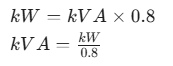
Example: If you need 400 kW of actual power, you will need a generator rated for at least 500 kVA.
2. Running Watts vs. Starting Watts (The Motor Factor)
One of the most common mistakes buyers make is only calculating the "Running Watts" of their equipment.
Industrial equipment with heavy electric motors (such as HVAC systems, industrial pumps, compressors, and heavy manufacturing machinery) requires a massive surge of power to start up—often 2 to 3 times higher than the power required to keep them running.
Running Watts: The continuous power needed to operate the equipment.
Starting (Surge) Watts: The initial burst of power needed for a few seconds to start a motor.
Sizing Rule: Your generator must be sized to handle the maximum starting load, not just the running load.
3. Step-by-Step Generator Sizing Guide
To accurately determine the size of the generator you need, follow these steps:
Step 1: Create an Equipment Inventory
Make a comprehensive list of all the electrical items, machinery, and lighting that the generator will need to power simultaneously during an outage or in an off-grid scenario.
Step 2: Determine Power Requirements
Check the data plates (nameplates) on your equipment to find the wattage. If the tag only lists Amps and Volts, use this formula to find the watts:

(Note: For three-phase equipment, the calculation is slightly more complex and involves the square root of 3).
Step 3: Calculate the Total Load
Add up the Running Watts of all your equipment. Then, identify the single piece of equipment with the highest Starting Watts. Add this highest starting surge to your total running calculation to find your peak power requirement.
Step 4: Add a Safety Margin (The 80% Rule)
Generators should not run at 100% maximum capacity continuously. For optimal fuel efficiency, engine lifespan, and to leave room for future business expansion, it is an industry best practice to operate generators at 70% to 80% of their rated capacity.
Once you have your total peak wattage from Step 3, divide that number by 0.8 to build in a 20% safety margin.
4. Single Large Generator vs. Parallel System?
For extremely high-power demands, relying on a single massive generator isn't your only option.
At Deman Power, we often recommend Parallel Power Solutions. For example, instead of one giant unit, we can synchronize multiple generators (e.g., configuring 14 units of 300 kW methanol generators to output a stable 4200 kW). Parallel systems offer built-in redundancy, better fuel scaling based on actual load, and seamless scalability for future growth.
Consult the Power Experts
Sizing an industrial generator involves complex variables, including harmonic distortions, voltage dips, and specific site conditions. While this guide provides a solid foundation, the safest way to protect your investment is to consult with professionals.
Not sure which unit is right for your project? Our engineering team at Deman Power provides free, comprehensive load assessments to ensure you get a robust, cost-effective, and perfectly sized power solution. Contact us today to discuss your diesel or clean-energy methanol power needs.
